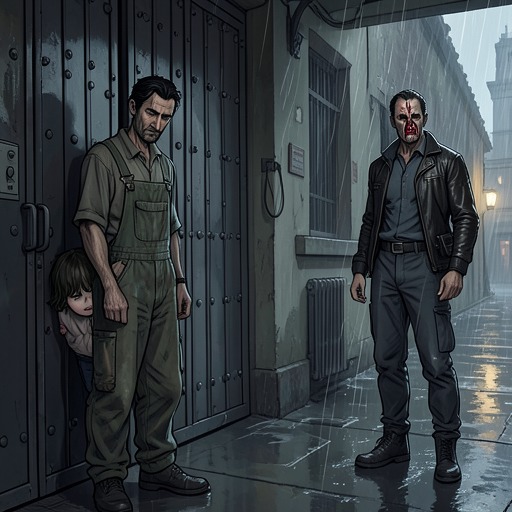
Vincent Dantier
Impure BloodVincent Dantier is a retired commissaire of the Brigade Criminelle de Nice and the father of its serving chief, Agnès Dantier. At eighty-eight, he remains active and willing to help when asked, but the kidnapping that reunites him with his daughter exposes a buried betrayal: decades earlier, Vincent informed on his colleague Adam Djourescu, an act that Jarret connects to his own family’s history and turns into a campaign of revenge. Vincent’s story joins a respected police career to the moral cost of a decision he had never disclosed to Agnès.
Identity and Career
Vincent is a former senior police officer and a prominent figure in the Brigade’s history. His daughter arranges for him to attend a briefing in her place as a representative of the office, with Roland Granot accompanying him. Although his eyesight has deteriorated, he remains active at eighty-eight and welcomes the opportunity. The arrangement also reflects the closeness between father and daughter: Agnès knows he will do anything for her, and followed him into the police, eventually reaching the rank of commissaire herself.
At the Monaco Conference Centre, Vincent is surprised by the scale of the gathering. He had expected an event for people like himself, not a crowd of officers and officials arriving alongside a helicopter. He speaks clearly and strongly, but his vision makes the descent of even shallow steps difficult. His depth perception is badly affected, and he holds the banister as he carefully makes his way toward the platform party. The contrast is marked: his physical judgment is impaired by failing eyesight, while his voice, presence, and long-standing authority remain intact.
Reputation and Relationship with Agnès
Granot remembers Vincent as a stocky, energetic and ingenious officer, a great commissaire who remained impressive in retirement. Former chiefs, Granot observes, commonly promise to help their successors only when asked; Vincent kept that boundary. Even when Agnès followed him into the commissaire’s office, he did not interfere. His attendance at the briefing, as she approaches retirement herself, is therefore not an attempt to reclaim authority but another instance of showing up when she needs him.
Agnès’s esteem for her father shapes how she measures other officers. Under pressure from the Palais to defend Paul Darac, she reflects that Darac’s integrity and refusal to become anyone other than himself make him the officer she has known who comes closest to measuring up to Vincent. The comparison places Vincent at the center of her personal standard for police conduct, not merely as a parent but as the exemplary figure against whom she judges professional character.
Their affection is visible again after both have been abducted. When Agnès wakes in the panel van, she finds Vincent there and reaches toward him, though her restraints prevent her from embracing him fully. Vincent is overcome with relief that she has returned to consciousness. Agnès reassures him that she is all right, concealing how frightened she is because she does not want him to see her fear. Even in captivity, she takes on the work of comforting him, while his relief makes plain how closely he experiences her peril.
The Kidnapping and Darac’s Investigation
When Agnès fails to report in, Darac first considers ordinary explanations and tries to contact her father. Vincent’s numbers lead to unanswered calls, and Darac leaves messages before attempting the landline. He recalls an earlier incident in which his own father slipped in the shower and could do nothing but wait for someone to return home; the memory helps explain why he does not dismiss the possibility that something has happened simply because Agnès has not called.
Granot eventually reports that Vincent has also been taken, with a ransom note matching the one left in Agnès’s case except for the change from “hers” to “his.” The simultaneous abduction of the current and a former commissaire changes Darac’s reading of the threat. Although the kidnappers have invoked the Sons and Daughters of the Just Cause and the Tour de France, Darac reasons that taking both Dantiers points to a personal crime disguised as a political one. He suspects revenge by someone they imprisoned or by an associate of such a person; the note, in this interpretation, is a smokescreen rather than the true cause.
The Past Revealed
The investigation reaches back to 1992, when Poupou’s brother died in prison. Darac tells him that he had written two letters to the officer responsible for the conviction—Vincent—and warned him to watch his back because he intended to kill him. Poupou recalls that his brother was close to him, believed the conviction had been unjust, and did not receive proper medical treatment in custody. His anger establishes one possible history of grievance against Vincent, but the later revelation identifies a different, deeper source of the kidnapping plot.
While held with Agnès, Vincent is asked to think of anyone who might hate them enough to punish and degrade them. He does not name anyone. The narration, however, shows that Adam Djourescu has come to mind: Vincent remembers him as the gifted colleague who surpassed him, and as a friend who shared his guilt over the wartime roundup of Jews. Vincent’s silence preserves the secret for a moment longer, even as the story makes clear that he recognizes the person at the center of the old grievance.
Jarret eventually lays out the history to Agnès and Vincent. He says Adam was Vincent’s contemporary at the Caserne, an accomplished officer who beat Vincent to the André Fonsec Medal in 1941 and repeatedly outperformed him. Jarret accuses Vincent of informing on Adam to gain an advantage at work and escape the position of second best. Vincent tries to dismiss the accusation as nonsense, but Jarret distinguishes his action from the earlier obedience of Vincent’s grandfather: Vincent, he says, acted on his own initiative.
The accusation links Vincent’s private rivalry to a much larger history of persecution. Jarret says Vincent’s grandfather had followed orders during the 1942 round-up of Jews, consigning many to their deaths; he then charges Vincent with using information against Adam for personal advancement. The distinction does not erase the catastrophe of the occupation, but it focuses the confrontation on Vincent’s own agency. His old decision is presented not as an order he had no choice but to obey, but as a calculated betrayal of a colleague and friend.
Jarret’s Revenge and Vincent’s Family Secret
Jarret explains that killing Vincent would have been a simpler form of revenge. Instead, he wanted Vincent to witness his own daughter’s suffering, making the punishment personal and directed through the bond Vincent most valued. When Agnès is alive before him, the revenge has failed to achieve its intended finality, but the threat has still forced Vincent to face the cost of the past through her endangerment.
The confrontation then reveals a secret about Jarret’s own family. He says his investigation began with only Vincent’s forename and that he eventually traced the connection. Vincent’s earlier actions, Jarret claims, did not succeed as intended: his aunt was given another chance, and his father—described as a baby thought stillborn—survived and lived as Jean Florian. Jarret says Jean’s life was ruined and in turn damaged other lives, and that this history was the route through which he began his long pursuit of Vincent. The revelation turns the kidnapping from an isolated act of retaliation into the consequence of intertwined family histories.
When Jarret identifies Jean Florian as his father, Vincent reacts with the question of whether Jarret is a son. Agnès recoils at the change in her father’s expression and hears a catch in his voice. His response suggests that Jarret’s disclosure has reached beyond the charge of professional betrayal: Vincent is confronted with a family connection and a life shaped by the consequences of his actions, at the same moment that his daughter is forced to hear what he had kept from her. The novel leaves Vincent’s relationship to this revelation suspended in that moment of recognition, with his silence and visible reaction carrying the weight of a past finally made public.